By Debra Simon
From simple church nuptials to Bridezilla blowouts, engaged women in the Triangle probably have one thing in common: a diamond ring.
These dazzlers may be forever, but it wasn’t always that way. The modern tradition of giving a sparkler is a mix of marketing and romanticism.
“No one really knows who wore the first,” says Marion Fasel, jewelry historian and co-author of “With This Ring: The Ultimate Guide to Wedding Jewelry.” “There are a lot of fairytales.”
Romans were among the earliest to use rings — specifically iron bands representing the cycle of life and eternity — to announce that people planned to marry, Fasel says.
Reliable research outside the jewelry industry is difficult to independently verify, but most sources identify the first diamond engagement ring as the gift Maximilian of Austria gave Mary of Burgundy in 1477 France.
One romantic legend tells of love letters that overcame the language barrier as Maximilian, who spoke a form of German, courted Mary through interpreters.
The archduke, cash poor because of Austria’s military campaigns, was said to have traveled though his native land, where villagers gave him gold and silver to purchase a ring for fair Mary.
The ring formed the letter “M” — representing both their names — set in gold and diamonds.
Reality may not have been so romantic. The two were originally married by proxy, and historians have suggested it was largely a political alliance. Some have said that Maximilian’s court counsel, rather than the archduke himself, came up with the idea.
Nevertheless, by the 16th century, the betrothal ring had evolved from fashion to tradition, though not for everyone.
“It really came about as something for royalty because they were the ones who could afford them,” Fasel says.
Even then, rings most often contained the bride-to-be’s birthstone, not a diamond.
That changed after World War II.
In 1947, advertising copywriter Frances Gerety penned the slogan “a diamond is forever” for powerhouse distributor De Beers.
The following year, De Beers used the line to kick off one of the most remarkable campaigns ever, says Jill Newman, former deputy editor of the Robb Report, a luxury consumer magazine at which she covered jewelry.
“The bright light did not go on with this until after World War II,” Newman says. “Before that, De Beers didn’t have the technology to mine the diamonds in mass quantity or the money and marketing power to pull it off.”
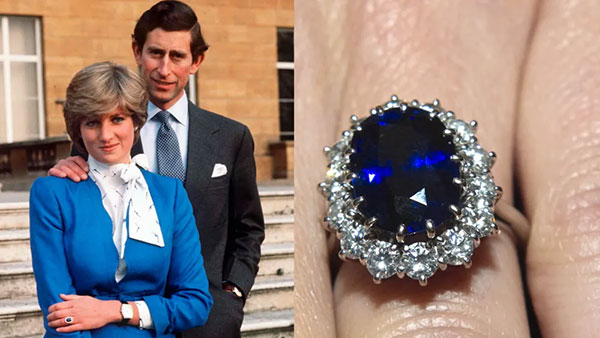
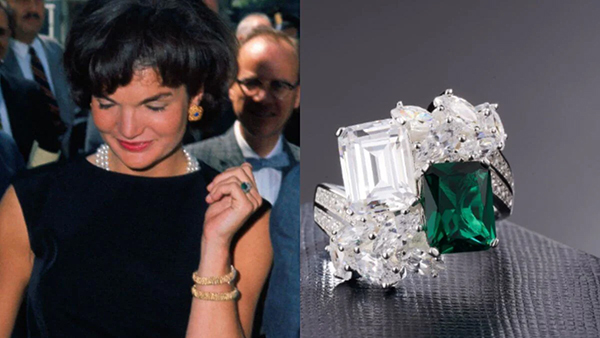
Celebrity rings, which drive trends and demand in the industry, haven’t always focused on diamonds.
Lady Diana Spencer, for example, chose an 18-carat oval sapphire in 1981. In 1953, John F. Kennedy’s matrimonial overture to Jacqueline Bouvier contained a set of large gems: a 2.88-carat emerald and an equal size diamond.
The single, solitaire stone also is a relatively recent fashion.
Audrey Hepburn’s and Marilyn Monroe’s engagement bling from the 1950s both were “eternity bands,” simple hoops of baguette-cut diamonds.
But no matter the shape or size of the symbol of engagement, Americans remain obsessed by the rock.