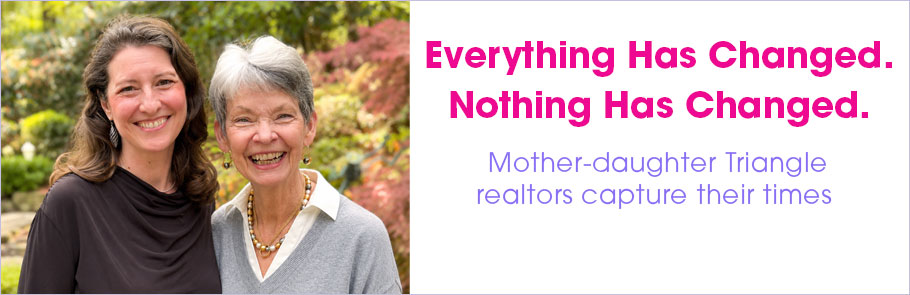
Between us, we represent two very different eras of real estate and two very different ways of doing business.
Lucia entered the profession more than 30 years ago and built her own company in a largely analog world. New listings arrived in weekly MLS reports and thick books with tiny, grainy photographs.
Buyers knew the bedrooms, square footage and perhaps a school assignment, but very little about how a house actually lived. There was no virtual tour, satellite view or algorithm to help fill in the blanks.
So, you got in the car.
 Those hours driving from house to house were part of the work. People talked about their children, jobs, budgets, fears and the life they hoped to build.
Lucia’s earlier experience as a schoolteacher shaped that perspective. A school can look excellent on paper and still not be the right environment for a particular child. A neighborhood can check every box and still not feel like home.
There is something meaningful about watching a business built by a woman in one era pass to her daughter in another. Lucia established her career before websites, social media and digital marketing made it possible to create visibility overnight. Reputation was built conversation by conversation, client by client.
Allison grew up inside that world. As a child, she rode along on showings. One couple she met while her mother was helping them choose a home later had children, and Allison babysat for them.
Today, after 22 years in real estate and advanced study in the field at Harvard, she brings an analytical lens to inventory, pricing strategy, buyer behavior, market cycles and the differences between individual Triangle submarkets.
That distinction matters. The Triangle is not one market. Cary is not Chapel Hill. Downtown Durham is not North Raleigh.
In 2026, rising inventory has given buyers more choice and more time, while stable pricing has rewarded realistic sellers and preparation.
Longer days on market do not automatically mean weakness, just as more listings do not automatically mean falling prices.
Technology helps us see all of that more clearly. Artificial intelligence can summarize a neighborhood in seconds. The school district, tax history and comparable sales can be learned before calling an agent.
But information is not judgment.
An algorithm can’t understand the fear of buying a first home, the uncertainty of meeting new neighbors or whether a school feels right for your child. A spreadsheet can’t tell you when a house feels like the place where your family belongs.
As Lucia gradually passes the business to Allison, we are learning that the analog and digital worlds are not opposites. They are strongest together.
That may be the larger lesson, whether you are buying a home or building a business: Embrace better tools, better data and new ways of thinking, but don’t mistake efficiency for wisdom.
It may seem as if everything has changed. But the human part has not.